





AI-Powered Test Automation & Quality Engineering: Self-Healing, Risk-Based Testing, and CI/CD Quality Gates
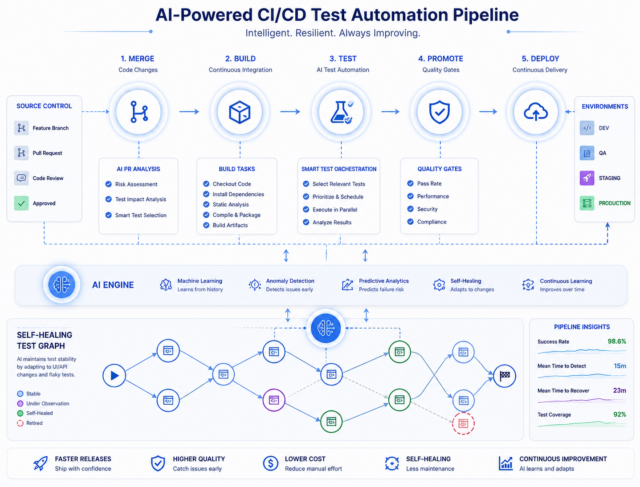
AI-powered test automation makes testing change-aware: fewer full-suite runs, more impact-scoped testing, and where supported self-healing and risk signals tied to the diff, not the calendar.

Self-healing automation

CI/CD quality gates
Why Release Velocity Broke the Old QA Model
The useful question is not “Does the build pass?” but “What changed, what could break, and what evidence do we have before we promote?”

Manual regression cannot keep pace
Weekly or faster shipping across web, mobile, and APIs means manual regression cannot keep pace with every integration path.

Risk concentrates at merge points
When several teams touch shared services, risk concentrates at merge points, not isolated modules.

More people and scripts don’t fix it
Programs that only add people or scripts often see regression cycles remain at 3–5+ days for large suites, while production escape rates stay high.
From Manual Testing to Intelligent Automation

Human judgment stays essential
Exploratory work, domain judgment, and human creativity remain essential. The limitation is repeatable coverage at release speed: the same headcount cannot re-validate a growing surface area on a shrinking release clock.

Automation creates a maintenance bill
Selenium- or API-driven automation provides CI/CD repeatability but creates a maintenance bill through flaky results, brittle locators, and rework after UI or rules changes. Many teams report 20 40% of automation effort going to break-fix and triage instead of new coverage.
What AI-Powered QA Changes in the Pipeline
Intelligent Quality Engineering uses change metadata—code, configuration, and prior failures to focus testing on the highest-impact areas.
smart test selection and parallel cloud runs.

and risk signals direct exploratory testing toward high-risk areas. Together, these capabilities shift QA from a calendar bottleneck to a quality signal generator within merge → build → promote.
Real-World Scenario: Healthcare Integration Releases
A healthcare platform ships frequently for regulatory and market demands, with integrations spanning payments, identity, and clinical data feeds. Each coordinated release increases integration regression risk.


Why Youngsoft for Intelligent QA
Many engagements stop at buying a tool or standing up scripts. Youngsoft takes an outcome-driven Quality Engineering approach, connecting pilot metrics to scaled automation while treating data and cloud as part of the same system.

AI-assisted automation, test data, quality analytics, and cloud-scaled execution aligned around the same risk and readiness story.

Engineering-led roadmaps focused on regression time, escape rate, and stability, rather than feature checklists.

Repeatable playbooks that move high-churn UI or API areas toward governed test data and CI/CD quality gates
AI-Powered QA & Quality Engineering Services

AI-assisted test strategy, tool fit, and implementation for self-healing and intelligent test selection.

Test data and quality analytics for defect trends, coverage vs. change, and readiness insights.

Cloud test execution and environment models aligned with release frequency and cost targets.

Digital transformation alignmentso QA modernization matches product and platform roadmaps.
Business Value: Measured, Not Assumed

Leadership: ~30–50% faster regression windows can improve time-to-market when shipping starts acting as a fixed multi-day tax. Track P1/P2 customer issues, production escapes, and hotfix counts— not only test pass rates.

QA and engineering:Less script repair and more coverage of high-risk journeys, with automation designed to remain resilient to UI and API churn.

End users:Fewer disruptive releases and a more predictable experience when quality signals guide promotion decisions.
Practical First Steps

Baseline:Capture regression duration, suite size, and escaped defects for four to six weeks before changing tools.

Define 90-day success:Target ≥30% regression time reduction or ≥25% reduction in break-fix hours, depending on the bottleneck.

Instrument the pipeline:Tie CI/CD quality gates to merge/build/promote and record change scope so intelligent test selection remains explainable.

Upskill:Train teams on triage, locator strategy, and risk interpretation—not only vendor UI navigation.
Conclusion: Trade Slogans for Instrumentation
Intelligent Quality Engineering works when AI-assisted automation is tied to CI/CD reality: less generic “coverage,” more evidence per hour spent.
Baseline one critical train, pilot intelligent test selection, self-healing automation, or risk ranking, and scale only after two consecutive releases hit pre-agreed targets.
The upgrade is not abstract “innovation”; it is shorter feedback loops and fewer production surprises, measured the same way your releases already are.